
You studied. Your grammar is clean. You order coffee and get exactly what you ordered.
And still, you can hear that you don't sound like the person in line behind you. You just can't point to what's different. Nothing you said was wrong. That's the frustrating part: there's no mistake to correct.
Here's one of the gaps, and it's smaller than you'd guess.
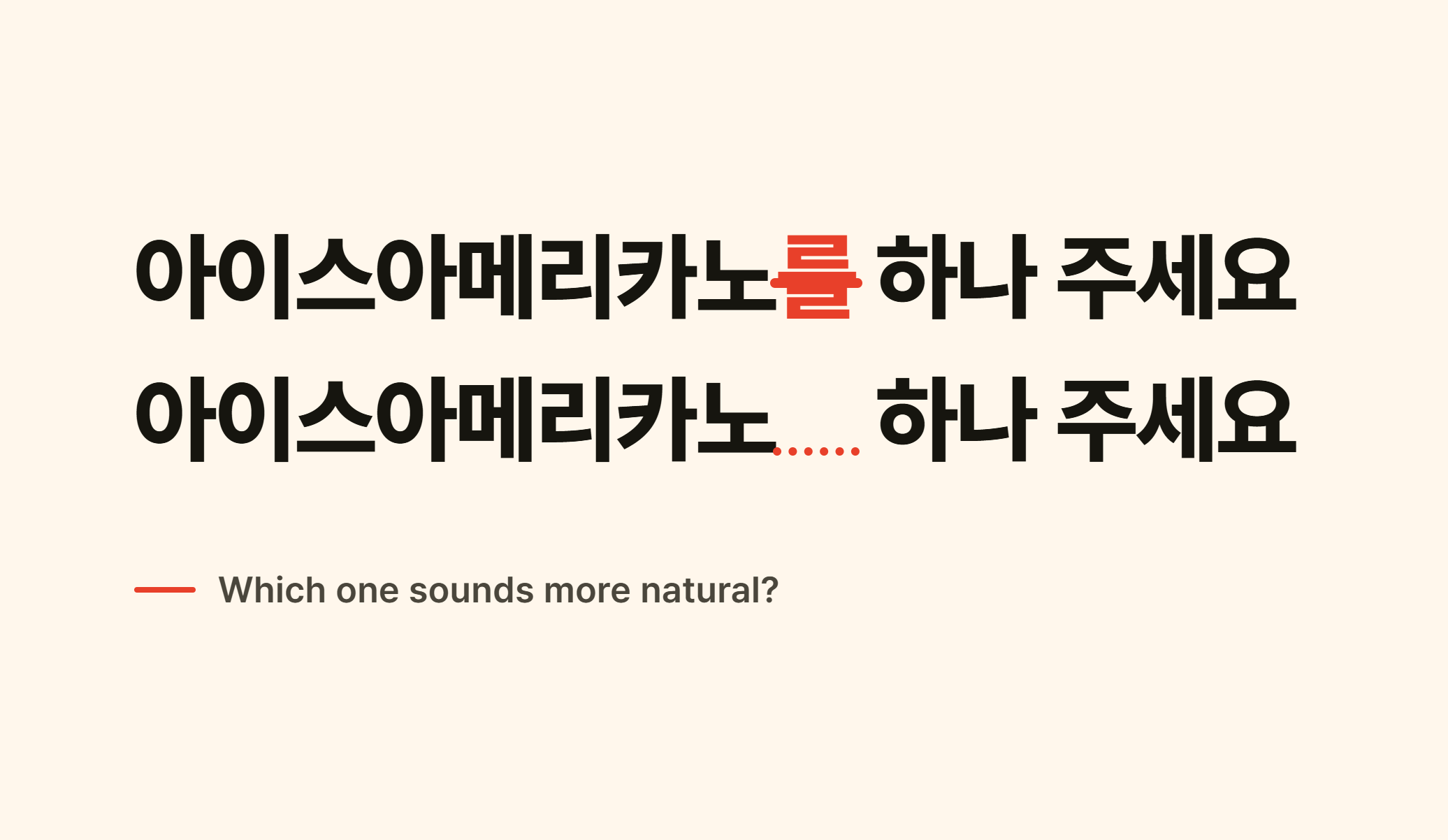
아이스아메리카노를 하나 주세요. (you)
아이스아메리카노 하나 주세요. (them)
Same words. One syllable shorter.
This post is about that syllable: the object particle 을/를. When Korean speakers drop it, when they keep it, and how to start doing it today.
The pattern
Korean marks the object of a sentence with 을/를 (eul/reul). Your textbook sentences almost always include it. In speech, people drop it constantly.
Why can they? Korean word order already does the job. The object usually sits right before the verb, so your listener knows what it is without the particle.
| Textbook | What you'll hear | Meaning |
|---|---|---|
| 이것을 주세요 | 이거 주세요 | This one, please |
| 밥을 먹었어요? | 밥 먹었어요? | Did you eat? |
| 커피를 마실래요? | 커피 마실래요? | Want some coffee? |
| 문을 닫아 주세요 | 문 닫아 주세요 | Please close the door |
| 사진을 찍어 주세요 | 사진 찍어 주세요 | Please take a photo |
Read the right column out loud. Noun, then verb, nothing in between. That's the rhythm you're after.
Neither column is wrong. The left one is just written Korean coming out of your mouth.
It's still polite
This is the worry that stops people, so let's kill it now.
Politeness in Korean lives in the verb ending, not the particle.
- 밥을 드셨어요? With the particle. Polite.
- 밥 드셨어요? Without it. Exactly as polite. Still fine for your boss.
Keep the -요. Drop the 를. No risk.
If anything, keeping every particle in casual speech is what sounds off. Not rude, just a little stiff, like reading from a script.
When to drop it, when to keep it
When you're speaking or texting, dropping it is the default. (KakaoTalk counts as speaking.) It drops most easily when the object is short, everyday, and obvious from context: 밥, 물, 이거, 커피, 사진, 봉투.
A short word between the noun and the verb doesn't change that. 물 좀 주세요. 아이스아메리카노 하나 주세요. Still no 를.
Keep 을/를 only when you have a reason. There are two.
- You're pointing at it. 그거를 왜 샀어? carries a that one, specifically. The particle puts the spotlight on the noun.
- You're writing something formal. An email to your 사장님 (sajang-nim, boss), a 신청서 (sincheongseo, application form), a report, an exam. Written Korean keeps its particles.
A long object doesn't change the default. In conversation, 어제 네가 추천한 드라마 봤어 is what you'll usually hear.
No reason? Drop it.
Only 을/를: don't strip the rest
The most common overcorrection. These particles carry meaning that disappears if you delete them:
- 은/는, 이/가: leave them alone for now
- 도 (also), 만 (only), 부터 / 까지 (from / until): these are the meaning
- 에 / 에서 / (으)로. One narrow exception: going somewhere. 집 가자, 학교 가요, 어디 가? Outside of that, keep them in.
Just 을/를. That's the whole assignment.
Say these this week
Already particle-free. Use them somewhere real.
- 이거 주세요 (igeo juseyo): This one, please.
- 물 좀 주세요 (mul jom juseyo): Some water, please.
- 봉투 주세요 (bongtu juseyo): A bag, please.
- 사진 좀 찍어 주세요 (sajin jom jjigeo juseyo): Could you take a photo?
- 밥 먹었어요? (bap meogeosseoyo?): Did you eat? (Near mealtimes this is closer to "I care about you" than an actual question.)
Say each twice, once with 를 and once without. You'll hear it.
Speech varies by region, age, and setting. This is a pattern, not a hard rule. Treat it as a starting point, then trust what you hear around you.